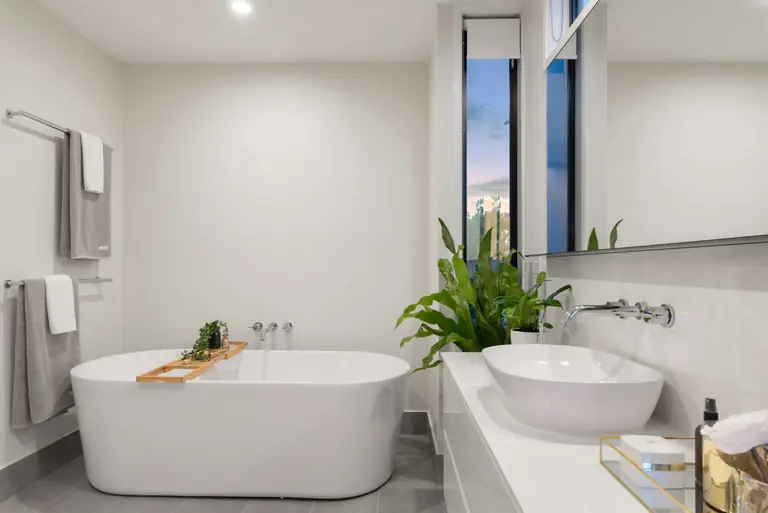
A full bathroom renovation strips the room back to its frame or slab and rebuilds every layer: the floor structure and falls, waterproofing, plumbing and electrical rough-in, wall linings, tiles and fixtures. In Newcastle most bathroom renovations cost $9,500 to $33,250, according to an independent cost guide updated in November 2026. Where your job lands in that range depends more on what's behind the old tiles than on the new ones you pick.
What's behind the tiles depends on the house. Bathrooms in Hamilton and Cooks Hill cottages often sit on a suspended timber floor, and that floor has to be sound before anyone can set falls on it. In Merewether and Bar Beach, salt air comes in off the water every day. A Charlestown or Lake Macquarie brick veneer usually has its bathroom on a concrete slab, so any drainage change means cutting concrete. If you treat the room as one connected system from the first conversation, the quote, the approvals and the build all stay easier to control.
Full renovation or cosmetic refresh: which one your bathroom needs
A full bathroom renovation replaces the parts of the room you'll never see again, as well as the surfaces. Each layer is sealed under the next. Tiles sit on a membrane, the membrane sits on a screed laid to fall, and the screed sits on a floor structure that has to be sound. You can't fix a buried layer later without pulling up everything above it.
A cosmetic refresh, sometimes called a re-skin, keeps the existing waterproofing, pipework and substrate and changes what sits on top. It costs less and finishes sooner. The catch is that your new finishes rely on old layers nobody has inspected.
| Scope | What changes | NSW cost band (2026) | Suits |
|---|---|---|---|
| Cosmetic refresh | Surface finishes, some fixtures, vanity, paint | $8,000 to $15,000 | Sound rooms where only the look has dated |
| Standard renovation | Strip-out, new membrane, rough-in, tiles, fixtures | $25,000 to $45,000 | Family bathrooms in typical three-bedroom homes |
| Premium renovation | Full rebuild with high-end fixtures and custom finishes | Regularly over $60,000 to $80,000 | Larger rooms, natural stone, freestanding baths, designer tapware |
These statewide bands come from The Quote Yard's 2026 NSW bathroom pricing guide. The Newcastle bands are in the cost section below.
A full renovation is the right call when:
- You're changing the layout. Moving a shower, toilet or vanity means new rough-in, so the floor and membrane get replaced anyway.
- You doubt the existing waterproofing. Laying new tiles over a membrane you don't trust carries the old risk into the new room.
- The substrate needs work. Floor framing, sheeting or screed repairs have to be done before waterproofing and tiling.
- The room has to work differently. Step-free access and grab-rail support are easiest to build in while the walls are open. If mobility matters for anyone in the house, now or later, see accessible and NDIS bathroom design.
A refresh can be enough when the room drains properly, there are no stains or loose tiles, and you're happy with where everything sits.
Size doesn't decide it. A small room that goes back to the frame is still a full renovation. The same Newcastle guide puts a small ensuite kept on its existing layout at $14,250 to $28,500. Our page on small bathroom and ensuite renovations covers the layout trade-offs in tight rooms.
The bathroom strip-out renovation: what comes out first
The strip-out removes everything being replaced, down to the frame or slab. It's also the point where you see the real size of the job. A typical bathroom strip-out renovation removes:
- Fixtures and fittings. Toilet, vanity, basin, bath, shower screen, tapware, mirrors and accessories.
- Wall and floor tiles, together with their adhesive bed.
- Old shower bases and bath hobs. Older rooms often have built-in bases or tiled hobs.
- Linings. The wall sheeting behind the tiles, plus the ceiling if it's being replaced too.
- Screed and membrane. The floor bed and any existing waterproofing come out so the falls can be reset.
- Redundant services. Pipework and wiring the new layout won't use.
Before anyone breaks old linings, find out what they're made of. Older fibre-cement sheeting can contain asbestos. Have suspect material tested. If the test is positive, a properly licensed removalist has to take it out under SafeWork NSW requirements. This isn't a job for a pry bar on a Saturday morning.
What the open room tells you
Once the room is stripped, the substrate gets inspected:
- Timber floors are checked for soft or damaged framing around the old shower and toilet.
- Slabs are checked to see where the drainage actually runs.
- Wall studs are checked behind the old wet zones.
Anything found here changes the price. A good quote names an allowance for hidden work and explains how variations will be priced. If a quote you're comparing has no line for this, ask why before you sign.
Full bathroom renovation cost in Newcastle
For a full bathroom renovation in Newcastle, What's The Damage? (last verified November 2026) gives these local bands:
| Newcastle tier | Typical cost | What it usually means |
|---|---|---|
| Basic | From $9,500 | Existing layout, standard tiles and fixtures |
| Small ensuite, existing layout | $14,250 to $28,500 | Compact room, plumbing left where it is |
| Mid-range fit-out | $19,000 to $33,250 | Family bathroom with better tile and tapware selections |
| Premium | $33,250 to $52,250 | Higher-grade finishes throughout |
| Luxury | $52,250+ | Custom work, larger rooms, top-end fixtures |
The bands are What's The Damage? figures for Newcastle.
To see how the money splits inside one job, the Going Rate estimator priced a sample Newcastle configuration at about $21,589, with most similar jobs landing between $18,600 and $24,600.
| Cost line, largest first | What moves it |
|---|---|
| Tiling and waterproofing | Wall and floor area, tile format and grade, floor-to-ceiling or part-height |
| Fixtures and tapware | Mid-range or premium tapware, freestanding bath, screen type |
| Labour and management | Number of trades to coordinate, site access, hidden repairs |
| Plumbing | Fixtures kept in place, or toilet, shower or vanity moved |
| Cabinetry and vanity | Off-the-shelf or custom, top material, width |
| Demolition and prep | Room size, floor type, substrate repairs, asbestos testing or removal |
The order follows Going Rate's Newcastle estimator, November 2026. Tiling and waterproofing takes the biggest slice of that sample, and demolition and prep the smallest. It describes one sample configuration, not a quote for your room.
Open the bathroom cost calculator
Put your own room through the bathroom cost calculator to see how size, layout and finish level change the total.
The two levers that move a quote most
The Quote Yard's 2026 NSW guide names both:
- Layout. Moving the toilet, shower or vanity can add $3,000 to $8,000 in plumbing.
- Finish level. Keeping plumbing where it is, using standard-format porcelain tiles and choosing mid-range fixtures keeps a standard bathroom in the $25,000 to $35,000 range statewide. Natural stone tiles, freestanding baths and premium tapware push the job to the top of its band.
Vanity tops and the engineered stone ban
Australia no longer allows new engineered-stone benchtops to be installed, and in NSW it's SafeWork NSW that polices it. If an older quote or a display vanity still lists an engineered-stone top, ask for a compliant alternative: natural stone, porcelain slab, solid surface or laminate.
The Newcastle bathroom cost guide breaks down each line further and shows where quotes tend to differ. Tiling and waterproofing is the biggest line in the sample, and it's also the layer that counts most after handover.
Waterproofing to AS 3740: the layer you never see again
The membrane has to follow the current Australian Standard, AS 3740:2021, as well as the building code requirements for each surface in the room. In NSW, waterproofing is licensed work. The NSW Government's waterproofing licence page, last updated 23 June 2026, says a contractor licence is needed for residential building or trade work, including waterproofing, valued at more than $5,000 in labour and materials including GST.
Tiles cover the membrane within days, so you need to check it before it disappears. Agree these hold points in writing before work starts:
- Substrate sign-off. Floor and wall surfaces are sound, clean and ready for the membrane.
- Falls checked. The shower floor and any floor waste fall the right way before the membrane goes over them.
- Membrane inspection. Upturns, corners, penetrations and the shower recess are inspected and photographed before tiling.
- Flood test. Ask whether your contractor does one, and at what stage.
- Paperwork. Get the licensed waterproofer's certificate or written record for your handover file.
The waterproofing compliance checker turns these hold points into questions to put to a renovator. For how membranes, wet-area zones and certificates fit together, see our wet-area waterproofing page.
Licences, HBCF insurance and contracts under NSW rules
Almost every complete bathroom rebuild is worth more than $5,000 including GST, so in practice you need a licensed contractor. The NSW Government says unlicensed work can bring fines of $22,000 for an individual or $110,000 for a company under the Home Building Act 1989. Contractor licences are issued for 1, 3 or 5 years, so make sure the licence is current. A licence number on its own doesn't prove that.
A standard family bathroom needs at least four licensed trades: a plumber, an electrician, a waterproofer and a tiler, according to The Quote Yard's 2026 NSW guide. Each has to finish its stage properly before the next one starts. Plumbing, drainage and gasfitting carry their own licensing requirements whatever the job is worth, and a general builder's licence doesn't cover them.
The second threshold is Home Building Compensation Fund (HBCF) cover. NSW generally requires it for residential building work over $20,000 including GST, subject to scope and exemptions, so confirm the current rule with NSW Fair Trading. Most of Newcastle's mid-range band of $19,000 to $33,250 sits above that line, which means most full renovations cross both the licence and the insurance thresholds.
Before you sign, work through these checks in order:
- Look up the contractor licence on the Service NSW builder or tradesperson licence check. Check the holder's name, licence class, conditions and expiry.
- Find out who does the specialist trades, and check their licences the same way.
- Get the HBCF certificate before you pay a deposit if the contract is worth more than $20,000 including GST.
- Get a written contract that lists retained, removed and new items, the hidden-work allowance and how variations will be priced.